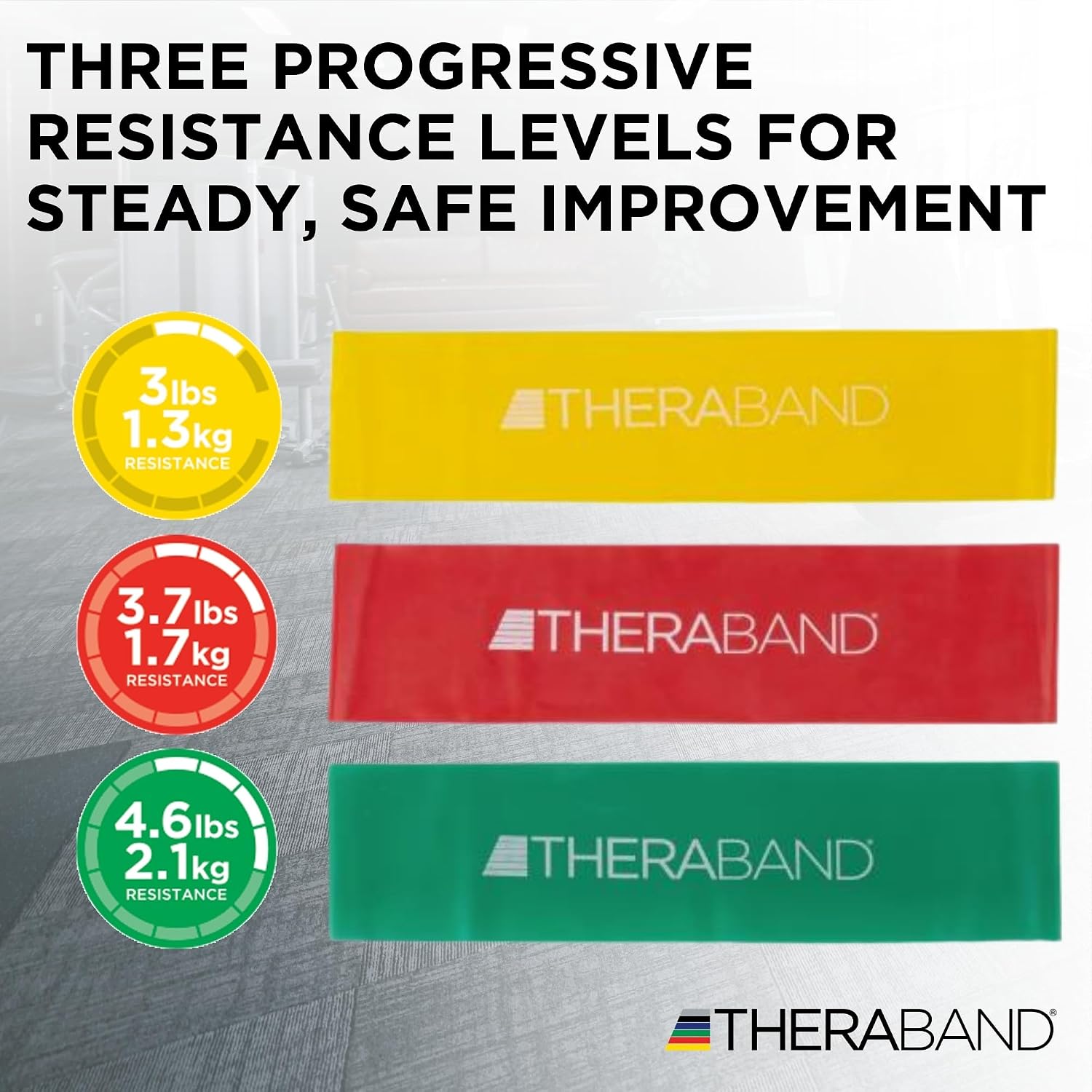
Long flat resistance bands — those wide, continuous loops or cut lengths of latex or TPE sheeting you’ve probably seen rolled up in a physical therapy clinic — look deceptively simple. But the difference between a band that delivers 3 lbs of pull at a standardized stretch length and one that delivers 6 lbs can mean the difference between appropriate early-stage rehabilitation and aggravating a healing tissue. If you’re a PT specifying bands for a clinical caseload, a strength coach programming band-assisted stretching, or a post-surgical patient trying to follow a home exercise program your clinician prescribed, the color-coded “tension level” printed on the packaging is only useful if the brand behind it has actually validated those numbers — and not all of them have.
This guide compares six brands on the variables that matter most for physical therapy stretching applications: published tension accuracy at standardized elongation percentages, material consistency across production runs, useful length for lower-extremity stretching protocols, and total cost of ownership for clinical volume purchases. We’re not adjudicating which band feels best in your hand; we’re asking which brands give you reliable, repeatable load delivery when precise dosing matters.
| EDITOR'S PICK[THERABAND Resistance Bands](https://www.amazon.com/dp/B00H6ZEXNM?tag=greenflower20-20) | Mid-tier[THERABAND Resistance Bands Set](https://www.amazon.com/dp/B000LX4KRA?tag=greenflower20-20) | Budget pick[SPRI Flat Bands 3-Pack - 3 Coun…](https://www.amazon.com/dp/B097QD67G9?tag=greenflower20-20) | |
|---|---|---|---|
| Material | Latex | Latex | — |
| Included | 1 band (6 yd) | Set | 3 bands |
| Length | 6 yards | — | — |
| Resistance level | Heavy | — | — |
| Color | Green | — | — |
| Price | $14.40 | $10.43 | $8.39 |
| See on Amazon → | See on Amazon → | See on Amazon → |
Why Tension Accuracy Is the Only Spec That Actually Matters
In clinical and semi-clinical settings, resistance bands function as load delivery tools — the same way a dumbbell does. The difference is that a dumbbell’s load doesn’t change based on how far you pull it; a band’s effective load increases with elongation, and that relationship is governed by the material’s elastic modulus. When a patient performs a supine hamstring stretch with a flat band looped around the foot, the tension they’re resisting at end range is a direct function of (a) how far the band is stretched beyond its resting length and (b) how accurately the manufacturer has characterized that tension for a given color grade.
Per indexed studies on elastic resistance calibration available through PubMed/NCBI — including work by Simoneau and colleagues on elastic resistance and muscle activity — even minor inconsistencies in band material density can produce meaningful force discrepancies at clinical elongation percentages (typically 100–200% of resting length for PT applications). The American Physical Therapy Association’s clinical practice resources on resistance band use in outpatient settings explicitly recommend that clinicians verify tension specs against manufacturer-published force tables rather than relying on color alone — because color systems are not standardized across brands.
That’s the core problem: TheraBand’s “yellow” is not the same as Perform Better’s “yellow,” which is not the same as a generic manufacturer’s “yellow.” Without published, elongation-specific force data, you’re guessing at dosage.
The Six Brands, Evaluated
1. TheraBand Classic (Latex)
TheraBand publishes the most granular tension data of any brand in this category — elongation-specific force tables at 25%, 50%, 75%, 100%, 150%, and 200% stretch are available directly in their product documentation at theraband.com. At 100% elongation (band doubled in length), the yellow Classic band is rated at approximately 1.3 lbs; red at 1.9 lbs; green at 2.5 lbs; blue at 3.6 lbs; black at 4.6 lbs; silver at 6.7 lbs; and gold at 8.4 lbs.
This granularity is clinically meaningful. It’s why TheraBand remains the default specification in most hospital-based PT departments and the reference standard in academic rehabilitation research. BarBend’s comparative resistance band review notes that TheraBand’s consistency across production batches is the most frequently cited reason PTs return to the brand after trialing alternatives.
Tradeoff to name explicitly: TheraBand Classic is latex. For latex-allergic patients — a non-trivial population in post-surgical and immunocompromised caseloads — this is a disqualifier unless you stock the TheraBand CLX or the non-latex alternatives below.
Price range: Approximately $8–$18 for 5-foot pre-cut lengths; $25–$55 for 25-yard dispenser rolls (clinical volume pricing varies by distributor).
2. TheraBand CLX (Latex-Free)
The CLX is TheraBand’s latex-free line, manufactured from thermoplastic elastomer (TPE). The published tension data tracks closely with the Classic line — the company’s force tables show roughly equivalent load at equivalent elongation percentages — but independent users and aggregate clinical feedback note that CLX bands feel slightly stiffer at low elongations and slightly more forgiving at high elongations compared to latex equivalents. This is a material property of TPE versus latex, not a manufacturing defect.
For practices that have standardized on TheraBand color coding, the CLX is the cleanest latex-free swap. The CLX format also features looped handholds integrated into the band, which users report meaningfully improves grip security during lower-extremity stretching protocols.
Price range: $30–$85 for clinical sets.
3. Perform Better Functional Resistance Bands
Perform Better publishes tension specifications in their product sheets (available at performbetter.com), though the data is less granular than TheraBand’s — Perform Better typically lists force at 100% elongation rather than across the full elongation curve. Their light band (red) is rated at approximately 1.5 lbs at 100% elongation; medium (green) at 2.5 lbs; heavy (blue) at 4.0 lbs; extra-heavy (black) at 6.0 lbs.
What differentiates Perform Better in clinical purchasing decisions is band length. Their standard flat bands are available in 5-foot and 6-foot pre-cut lengths, and the 6-foot option is consistently flagged by clinicians working with taller patients or full lower-extremity protocols as more practical than the 5-foot standard. Perform Better bands are latex; no TPE equivalent is currently listed in their catalog.
Tradeoff: The less granular tension data means you’re interpolating between data points for programming precision. For straightforward stretching protocols with color-coded home exercise programs, this is workable. For clinical research applications requiring precise load documentation, TheraBand’s fuller tables are the cleaner choice.
Price range: $12–$22 per band; volume sets available through Perform Better’s clinical sales channel.
4. Hygenic / Performance Health Non-Latex Resistance Bands
Performance Health — the parent company of TheraBand — also distributes a non-latex band line under the Hygenic brand, commonly found in hospital purchasing catalogs. Tension specs largely mirror TheraBand CLX data, which is expected given shared parentage. The main differentiation is packaging: Hygenic bands are frequently available in bulk dispenser rolls optimized for cutting to patient-specific lengths in inpatient and acute care settings where pre-cut lengths create waste.
For outpatient private practice, this format advantage is marginal. For hospital-based PT departments managing high patient volume and diversity of limb length, it’s a real operational benefit.
Price range: Dispenser rolls $30–$60; pricing varies significantly through group purchasing organizations (GPOs) commonly used in hospital procurement.
5. Bodylastics Resistance Bands (Flat Loop Format)
Bodylastics is primarily known for its tube-band stackable systems, but their flat loop bands have gained traction in home gym and semi-clinical settings. Published tension data is less systematically documented than TheraBand or Perform Better. Bodylastics lists weight equivalencies on packaging (e.g., “5–8 lbs”), but these are tested at a specific stretch length that isn’t always consistently disclosed across product pages.
BarBend’s review of Bodylastics notes strong durability and good latex quality in the flat band line, with reviewers reporting consistent feel across multiple bands of the same color. However, the lack of elongation-curve data makes Bodylastics a weaker clinical specification choice compared to TheraBand. Where they earn their place is in home program compliance: the packaging language resonates with patients who think in pounds rather than percentage elongation, and that can improve adherence.
Price range: $15–$35 for sets.
6. WODFitters Flat Resistance Bands
WODFitters has built market share in the CrossFit and functional fitness segment, and their flat bands have crossover use in assisted stretching and mobility work. Tension data on WODFitters flat bands is the least systematically published of the six brands reviewed here — the company primarily markets by width and color rather than calibrated force tables. Aggregate user reviews across fitness communities describe consistent resistance within a color, but without independent elongation testing, this is owner-reported consistency rather than verified calibration.
WODFitters flat bands are most defensible in strength and conditioning contexts — band-assisted stretching for athletes in a performance setting — rather than clinical PT applications where precise load documentation is required. For an intermediate home-gym builder using bands for hip flexor or hamstring stretching as part of a general mobility routine, WODFitters delivers value at a lower price point. For a PT documenting treatment resistance in a medical record, the missing force tables are a material gap.
Price range: $10–$25 for individual bands; sets available in the $30–$60 range.
By the Numbers: Approximate Tension at 100% Elongation, Medium Grade
| Brand | Medium Band | ~Force at 100% Elongation | Data Granularity |
|---|---|---|---|
| TheraBand Classic | Green | ~2.5 lbs | Full elongation curve published |
| TheraBand CLX | Green | ~2.4 lbs | Full elongation curve published |
| Perform Better | Green | ~2.5 lbs | Single-point (100%) published |
| Hygenic / PH | Green | ~2.4 lbs | Mirrors TheraBand CLX |
| Bodylastics | Medium | ~2.5–3.0 lbs est. | Weight range on packaging |
| WODFitters | Medium | Not systematically published | User-reported only |
Force values derived from manufacturer-published documentation and Perform Better product spec sheets. Bodylastics estimate based on packaging weight equivalency at stated stretch length.
Decision Framework: If X, Then Y
The “it depends” answer isn’t useful when you’re making an actual purchasing decision. Here’s how to resolve the choice cleanly:
If you’re specifying bands for a clinical outpatient PT practice and need documentation-grade tension accuracy: TheraBand Classic (latex-tolerant patients) or TheraBand CLX (latex-free requirement) is the correct answer. The published elongation-curve data is the only way to document treatment resistance with clinical precision. Per the APTA’s clinical practice resources, this traceability matters when outcomes need to be reproducible across clinicians.
If you’re equipping a hospital-based or inpatient setting with high patient throughput and variable limb lengths: Add Hygenic dispenser rolls to your TheraBand baseline for cutting flexibility. The GPO pricing can also meaningfully reduce per-unit cost at volume.
If you’re a strength coach or athletic trainer programming band-assisted stretching for performance athletes and don’t need clinical documentation: Perform Better’s 6-foot bands offer the most practical format for tall athletes, with adequate published specs for load progression.
If you’re building a home rehabilitation program and your clinician has given you color-coded instructions in TheraBand colors: Buy TheraBand. The color system your clinician specified was almost certainly calibrated against TheraBand’s published tables; substituting a different brand’s “green” breaks that calibration.
If you’re a home-gym user adding flat bands for general mobility and stretching without a clinical protocol: Bodylastics or WODFitters deliver honest value at lower price points, and the precision gap doesn’t matter when you’re not documenting treatment resistance.
The underlying principle, per Stronger by Science’s analysis of accommodating resistance and Simoneau et al.’s research indexed through PubMed/NCBI: resistance dosing precision matters more as clinical stakes increase. Scale your specification accordingly, and don’t pay for clinical-grade documentation tolerance if your use case doesn’t require it. But if it does, TheraBand’s published data infrastructure is genuinely irreplaceable in this product category — no other brand in this comparison has matched it.