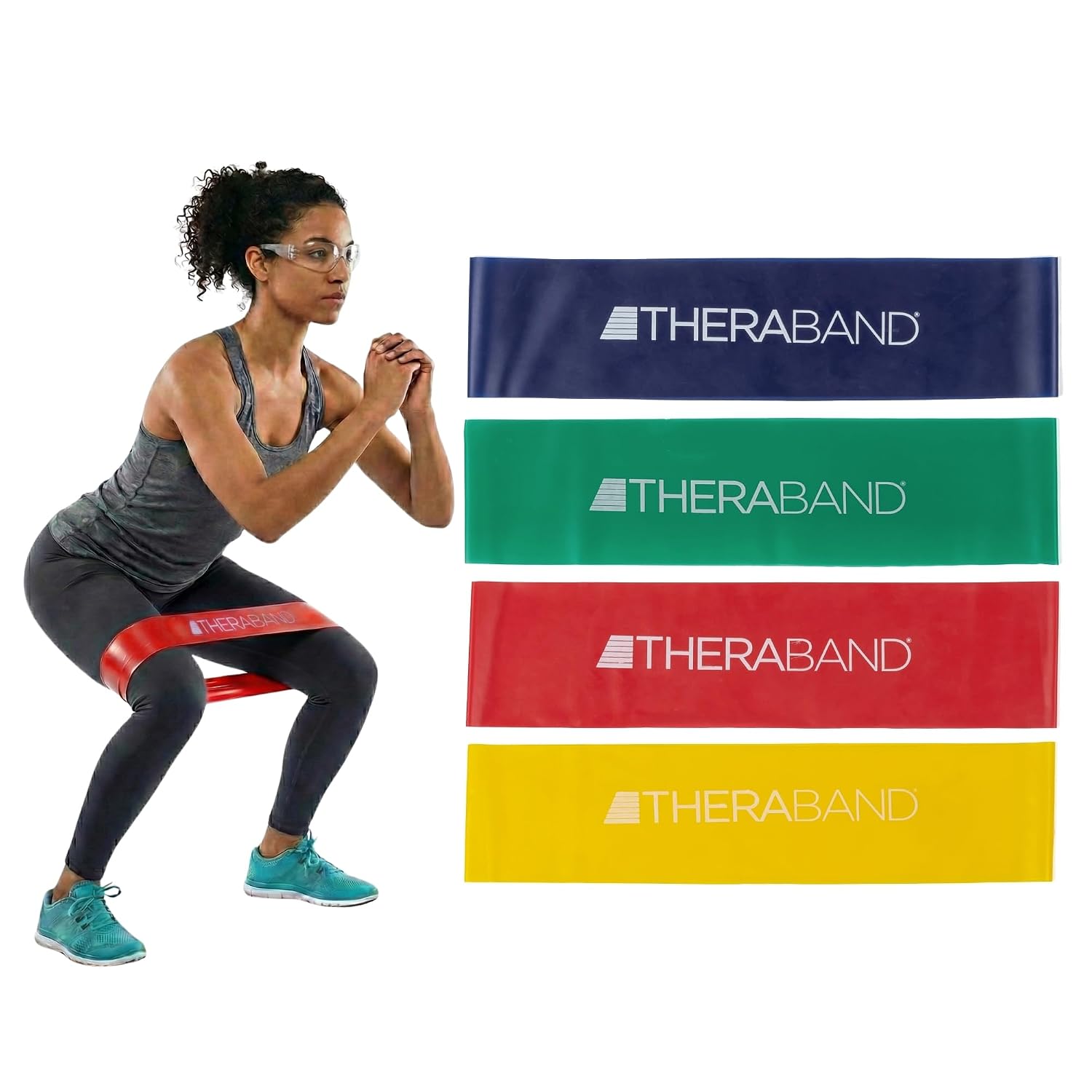
Mini loop bands — the small, closed rubber or fabric loops that sit around your ankles, knees, or thighs — are one of the most widely recommended tools in both physical therapy clinics and strength training programs. If you’ve ever been handed one by a physical therapist (a licensed clinician who designs exercise programs to restore movement and reduce pain) or seen them stacked at the end of a barbell warm-up rack, you already have the idea. They add resistance (a force that muscles have to work against) to movements that would otherwise be too easy to drive meaningful adaptation or too heavy to perform safely during recovery. The problem is that “resistance” is a spectrum — and the gap between a 5-lb band and a 25-lb band, at the same movement speed, can mean the difference between effective loading and a setback. This guide breaks down how to read resistance specs, which bands hold up across product categories, and — critically — how to match the number on the label to what’s actually happening at the hip and knee joint during common rehab and activation protocols.
| EDITOR'S PICK[Power Systems Versa Loops Comme…](https://www.amazon.com/dp/B07T2M9KMG?tag=greenflower20-20) | Mid-tier[Perform Better Mini Band Resist…](https://www.amazon.com/dp/B01GVS9EQK?tag=greenflower20-20) | Budget pick[Sweet Sweat Mini Loop Resistanc…](https://www.amazon.com/dp/B07F58T83Q?tag=greenflower20-20) | |
|---|---|---|---|
| Pack count | 10 | 4 | 5 |
| Dimensions | — | 9x2 in | — |
| Resistance levels | Color coded | Set of 4 | Set of 5 |
| Material | Commercial grade | — | — |
| For rehab | — | Exercise bands | ✓ |
| Price | $49.99 | $19.95 | $12.56 |
| See on Amazon → | See on Amazon → | See on Amazon → |
Why Resistance Specification Matters More Than Color
Walk into any clinic supply room and you’ll see TheraBand’s color-coded system: yellow, red, green, blue, black, silver. It’s intuitive until it isn’t. Per TheraBand’s own resistance band color-coding and tension reference guide, a standard TheraBand flat band rated at 100% elongation (meaning stretched to double its resting length) generates approximately 1.7 lbs of force at yellow and climbs to roughly 6.7 lbs at black. Mini loop bands — a different product category that sits closer to the body and moves through a shorter arc — operate on different force curves entirely.
This is the first tradeoff every practitioner needs to internalize: color ≠ resistance, especially across brands. A “medium” green band from one manufacturer may deliver 12 lbs of peak tension at hip-width stance; a “medium” green from another may deliver 20 lbs at the same position. Barbend’s 2025 resistance band roundup notes that tension inconsistency across brands is one of the most persistent sourcing problems for home-gym buyers, and it’s no less true for clinical buyers.
By the numbers:
- TheraBand CLX “Medium” (green): ~3.6 lbs at 75% elongation per manufacturer documentation
- Perform Better mini loop “Medium”: typically 10–15 lbs depending on loop circumference (per Perform Better product specs)
- Rogue Fitness shorty monster band equivalent: 35–50 lbs at comparable stretch — far outside rehab range
- Fabric mini loop bands (e.g., Bodylastics, WODFitters): manufacturer-stated resistance 10–30 lbs, but elongation-curve data is rarely published
The clinical takeaway: always anchor to the manufacturer’s force-at-elongation data, not the color or descriptor label. If a brand doesn’t publish those numbers, that’s itself a data point worth weighing.
Rehab Use Cases: What the Protocol Actually Demands
Let’s get specific about load requirements, because “rehab” covers an enormous range.
Early-Stage Post-Surgical Protocols (Weeks 1–6)
Following procedures like ACL reconstruction or hip labral repair, the American Physical Therapy Association’s clinical guidelines emphasize neuromuscular re-education and pain-free range of motion before any meaningful loading. At this stage, mini loop bands serve primarily as proprioceptive tools (devices that help the nervous system re-learn where the limb is in space) rather than true resistance training implements.
Resistance targets here are typically 1–5 lbs of tension across the movement arc. TheraBand’s yellow and red clinical loop bands are well-matched to this range. Fabric bands are generally too stiff at their minimum; even a “light” fabric loop from most consumer brands generates 8–12 lbs of initial pull-apart force, which overshoots early-stage protocols and can provoke compensatory movement patterns before the joint is ready. In clinical settings, TheraBand CLX sets ($30–$85 for multi-pack) remain the reference standard precisely because their elongation curves are published, peer-reviewed, and consistent batch-to-batch — a point reinforced by Perform Better’s clinical product documentation.
Mid-Stage Activation and Strength Re-Education (Weeks 6–16)
This is where mini loops earn their reputation. Hip abductor activation protocols — clamshells, side-lying hip abduction, lateral band walks, monster walks — require enough resistance to challenge the glute medius (the fan-shaped muscle on the outer hip responsible for pelvis stability) without overpowering the movement and recruiting the TFL (tensor fasciae latae, a smaller hip flexor that tends to compensate when the glute is underloaded or fatigued).
Stronger by Science’s overview of resistance band training notes that for glute medius isolation, the band should create noticeable resistance at the end range of motion (the outermost point of a clamshell, for instance) while allowing full range to be completed without a Trendelenburg drop (a telltale hip hike that signals the target muscle is losing the battle). In practice, this usually means 8–15 lbs of tension across the arc for most intermediate-rehab adults.
The format tradeoff here is significant:
- Latex mini loops (traditional): Higher elasticity, more consistent elongation data, lower cost ($8–$18 per set of 5). Prone to rolling during lateral walks; latex sensitivity is a contraindication for some patients.
- Fabric mini loops (cloth-covered rubber or TPE cores): Stay in place on skin and clothing, better for lateral walk patterns. Force curves are less linear and harder to audit. Owners report more durability over time but greater inter-unit variability ($15–$35 for a quality set).
For mid-stage rehab where protocol compliance across a home-exercise program matters, fabric bands earn a practical edge — patients are more likely to perform lateral walks correctly when the band doesn’t migrate toward the ankle. Barbend’s reviewer panel consistently surfaces this as the deciding factor in consumer band selections for movement-pattern work.
Late-Stage Return-to-Sport and Glute Strength Loading (Weeks 16+)
By this point, the goal shifts from activation to genuine loading. A clamshell at 5 lbs stops being useful when the glute medius can handle 25 lbs without compensation. This is where the practitioner decision branches:
Option A: Stay in the mini loop category, go heavier. Some brands (WODFitters, Bodylastics) offer fabric loops in the 25–35 lb range. These work for movements like banded squats, hip thrusts with a loop at the knee, and standing hip abduction against meaningful load.
Option B: Transition to long-loop bands or dedicated hip resistance systems. At this stage, the EliteFTS pull-apart band format or a Rogue shorty monster band (at its lightest, approximately 10–35 lbs) can provide more scalable resistance for compound patterns, even if the mini loop remains in rotation for warmup work.
The decision rule is mechanical: if your athlete is completing 3 sets of 20 reps with no visible fatigue signal and full control at end range, the mini loop has served its purpose in that pattern. Progress the load or the pattern — don’t keep repeating a stimulus that no longer creates adaptation.
Matching Band Specs to Three Common Protocols
Here’s a practical reference frame for the three most frequently prescribed mini-loop movements, mapped to resistance targets and appropriate product tiers:
Clamshell (side-lying hip external rotation)
- Rehab target: 3–10 lbs tension at end range
- Best format: Latex mini loop, TheraBand red or green clinical loop
- If progressing: Fabric loop, 12–18 lbs stated resistance
Lateral Band Walk (hip abductor strengthening in gait pattern)
- Rehab target: 10–20 lbs tension at hip width
- Best format: Fabric mini loop (stays in position); 15–25 lb range
- Key spec to check: Does the brand publish tension at hip-width elongation specifically? If not, assume the stated number is peak tension at maximum stretch — which overstates working load by 30–50%
Banded Hip Thrust or Glute Bridge (posterior chain loading)
- Activation target: 15–30 lbs at knee-width position
- Best format: Heavier fabric loop OR thin long-loop band placed at knees
- Note: Mini loops placed above the knee during hip thrust primarily cue abductor engagement to prevent knee cave; the load here is secondary to the proprioceptive signal
Cost Transparency and Kit-Building Logic
For a clinical practice building out patient home-exercise kits, the cost math runs roughly as follows in mid-2026:
- TheraBand CLX multi-pack (6 colors/resistances): $50–$85 per set — published specs, latex, highest clinical auditability
- Perform Better mini loop sets (latex, 4-pack): $20–$35 — clinical-grade durability, less comprehensive elongation documentation than TheraBand
- Fabric mini loop 5-pack (Bodylastics, WODFitters): $18–$35 — practical for lateral walk patterns, variable inter-unit resistance, limited spec transparency
- Fit Simplify latex loop set (5-pack, entry): $8–$12 — adequate for early-stage activation if you verify the tension matches the protocol; color labeling is inconsistent with TheraBand equivalents
For a home-gym athlete assembling an activation and rehab toolkit without clinical oversight, a dual-kit approach works well: one set of light latex loops (TheraBand or equivalent) for early activation work and one fabric set in the 15–25 lb range for loaded movement patterns. Total outlay: $30–$55 covers most use cases across a periodized program.
The Decision Rule
If you’re a PT equipping patients for home programs, TheraBand CLX or Perform Better clinical loops are the defensible choice — not because fabric bands are inferior, but because published elongation data lets you prescribe load with confidence and adjust when a patient plateaus. Auditability matters when you’re the clinician of record.
If you’re a strength coach or intermediate athlete building a warm-up and activation sequence around compound lifting, fabric mini loops in the 15–25 lb range solve the one practical problem latex doesn’t — they stay where you put them during lateral movement patterns. Use them for the loaded patterns and keep a lighter latex loop for the early-set neuromuscular work.
If you’re a rehab patient working from a protocol sheet, match the band color or descriptor to your clinician’s prescription, but ask one question: what brand is the recommendation based on? A green TheraBand and a green no-name fabric loop are not interchangeable prescriptions. That single clarification can be the difference between progressing on schedule and spending two extra weeks wondering why the movement still doesn’t feel right.
The bands are simple. The selection decision, when you do it carefully, is where the outcome gets made.