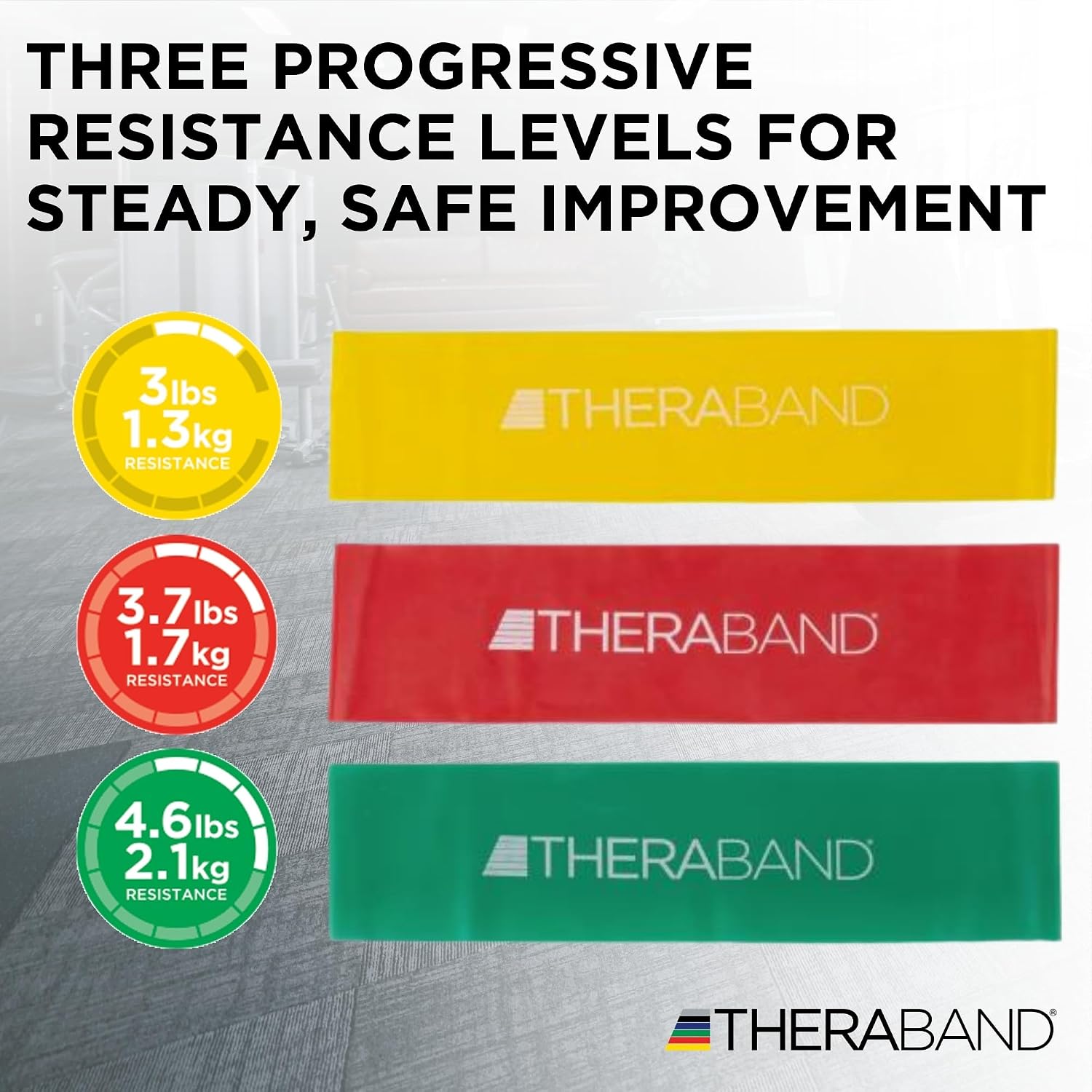
Your rotator cuff is a group of four muscles and their tendons that wrap around the shoulder joint, keeping the ball of the upper arm seated firmly in its socket while your arm moves. When one of those tendons is torn, inflamed, or surgically repaired, the rehab process almost always involves resistance bands — lightweight, color-coded elastic tools that let you load the shoulder at very low, carefully controlled intensities before it’s ready for dumbbells or barbells. The problem is that “resistance band” means almost nothing on its own. A yellow TheraBand and a black WODFitters loop live on opposite ends of the tension spectrum, and using the wrong one at the wrong stage of recovery doesn’t just slow you down — it can re-injure tissue that’s still consolidating. This article cuts through the color-code confusion and gives you a framework for selecting band tension by protocol phase, not by what looks appropriate on a product page.
| EDITOR'S PICK[SPRI Xertube Resistance Bands w](https://www.amazon.com/dp/B0FNDLRKXG?tag=greenflower20-20)… | Mid-tier[THERABAND Resistance Bands Set](https://www.amazon.com/dp/B01A58FHQ8?tag=greenflower20-20) | Budget pick[RitFit Single Resistance Exerci](https://www.amazon.com/dp/B074GSLQ3V?tag=greenflower20-20)… | |
|---|---|---|---|
| Resistance levels | — | Set (multiple) | Single |
| Handles included | ✓ | — | ✓ |
| Door anchor included | ✓ (optional) | — | ✓ |
| Material | — | Latex | — |
| Price | $14.00 | $10.43 | $7.99 |
| See on Amazon → | See on Amazon → | See on Amazon → |
Why Band Tension Is the Whole Ballgame in Rotator Cuff Work
Rotator cuff rehab is not a strength program that happens to use light weights. It’s a tissue-loading program designed around very specific force windows. The APTA’s Clinical Practice Guidelines for Shoulder Pain and Mobility Deficits are explicit: early-phase rotator cuff exercises should produce fatigue at high rep ranges (15–30 reps) with zero pain above a 2/10 on the visual analog scale. That protocol specification immediately tells you something useful: you’re not looking for a band that challenges you at 8–12 reps. You’re looking for a band that makes 25 controlled reps of external rotation genuinely tiring — not crushing.
The tricky part is that manufacturers don’t standardize tension ratings. As Stronger By Science’s review of resistance band tension variability notes, two bands from different brands labeled “medium” can differ by 40–60% in actual resistance at the same extension length. That variability matters enormously when the target tissue is a partially healed tendon operating at 30–60% of its pre-injury tolerance.
Here’s what the numbers actually look like in clinical practice:
By the numbers — rotator cuff load targets by phase:
| Rehab Phase | Rep Target | Pain Limit | Approximate Band Resistance at Working Length |
|---|---|---|---|
| Phase 1 (acute/post-surgical, weeks 1–6) | 20–30 reps | ≤ 2/10 | 0.5–2 lb (minimal — TheraBand Yellow/Red equivalent) |
| Phase 2 (subacute, weeks 6–12) | 15–20 reps | 0/10 | 2–5 lb (light — TheraBand Green/Blue equivalent) |
| Phase 3 (strength/return to sport, weeks 12+) | 10–15 reps | 0/10 | 5–12 lb (moderate — TheraBand Black/Silver or light loop band) |
Sources: TheraBand CLX Clinical Reference Guide; APTA Shoulder CPG; PubMed systematic review on rotator cuff rehabilitation concepts.
Understanding the Two Band Formats — and When Each One Fits
Rotator cuff rehab almost exclusively calls for two band formats: theraband-style flat bands (long, continuous strips of flat latex or resistance material) and loop bands (short closed loops, sometimes called mini-bands). They behave differently, and the format decision isn’t arbitrary.
Flat therapy bands — the kind TheraBand and Perform Better produce in their clinical lines — give you a long working length, which means gentler load progression. When you’re doing side-lying external rotation or standing band pull-aparts in Phase 1 or 2, the longer the band, the more forgiving the tension curve. You can fine-tune load by changing your grip point on the band without swapping products. This is exactly why licensed PTs equipping clinical practices lean toward TheraBand CLX sets ($30–$85 for a full progression kit) or Perform Better’s flat band systems. The CLX system’s linked-loop design adds one more advantage: it lets patients with limited grip strength anchor the band without improvising. Per Perform Better’s published clinical notes, their flat band series is calibrated to tighter tolerances than recreational loop bands, which matters when you’re loading an early-stage repair.
Loop bands come into rotator cuff rehab primarily in Phase 2 and Phase 3, once tissue tolerance supports exercises like banded shoulder abduction, resisted diagonal patterns, and scapular stabilization work. The shorter length means the force curve rises more steeply with elongation — that’s useful for training the end-range stability the rotator cuff is actually supposed to provide. Brands like Bodylastics and WODFitters publish tension-at-length specifications in their product listings; cross-reference those numbers against the phase targets in the table above before purchasing. The caveat from the Stronger By Science analysis stands: verify the stated resistance at the actual elongation you’ll be using in your exercise, not at maximum stretch.
The tradeoff in plain terms: flat bands give you more granular control and a forgiving load curve — ideal for Phases 1 and 2. Loop bands give you more natural exercise setups for Phase 3 strengthening and are easier to anchor. Most practitioners end up using both.
Matching Specific Bands to Each Rehab Phase
Let’s get specific about product selection, because “light band” is as meaningless as “light weight.”
Phase 1: Post-Surgical or Acute Inflammation
You want essentially no resistance — the goal is neuromuscular activation and pain-free range of motion, not loading the repair site. The TheraBand Yellow (resistance: approximately 0.5–1.5 lb at moderate extension) is the clinical standard, and that’s not an accident. The APTA’s shoulder CPG references TheraBand’s color system as a clinical benchmark precisely because the tension values are published and reproducible. For patients recovering from surgical repair (SLAP, partial-thickness tear, full-thickness tear with anchor), this phase is often 6 weeks or longer — and some days, even Yellow is too much.
Decision rule: If the patient is post-surgical or in an active inflammatory phase, start with TheraBand Yellow or Red. Do not let a product’s marketing language (“beginner,” “light”) substitute for checking the published tension range.
Phase 2: Subacute — Loading the Healing Tissue
At 6–12 weeks post-injury or post-surgery (timelines vary significantly — defer to the supervising clinician), the focus shifts to loading the cuff tendons progressively to stimulate collagen remodeling. The PubMed systematic review on rotator cuff rehabilitation concepts (2023, NCBI) identifies progressive eccentric loading as a key driver of tendon adaptation at this stage. Band selection needs to support both the concentric and eccentric portions of exercises like external rotation and scaption (raising the arm in the plane of the scapula).
TheraBand Green and Blue occupy this window. If you’re working from a home-gym setup and the TheraBand CLX system isn’t accessible, Perform Better’s mini-band progressions (their Light and Medium flat bands) are a well-documented clinical alternative. Bodylastics’ tension-rated sets are a reasonable home option if you verify the lb-resistance specs at the extension length you’re using — the company publishes those numbers, which puts them ahead of many generic loop-band brands.
Decision rule: Phase 2 is where most patients under-load (staying on Yellow too long) or over-load (jumping to a loop band that delivers 10–15 lb). If the patient is completing 20 reps of side-lying ER with zero compensation and zero pain, they’re ready to progress tension — not ready to switch to a different exercise format entirely.
Phase 3: Strength and Return to Sport
Phase 3 is the window where the rotator cuff work starts to look more like training and less like therapy. Exercises become more integrated — resisted overhead diagonal patterns, banded push-up plus variations, Elbow-out rows with a loop band anchored at hip height. The NSCA’s Essentials of Strength Training and Conditioning (4th Ed.) frames shoulder stability training as a prerequisite for any overhead loading, and the band selection here reflects that: you need enough resistance to generate genuine fatigue at 10–15 reps without exceeding the cuff’s load tolerance.
TheraBand Black and Silver, or light loop bands from WODFitters or EliteFTS (their pull-apart bands, manufacturer-rated at 10–35 lb depending on width), are appropriate here. For competitive athletes and powerlifters integrating band pull-aparts into their warm-up and accessory work, the EliteFTS or Rogue Fitness Shorty Monster Bands are worth considering — but with a firm caveat: those bands are designed for accommodating resistance on compound lifts, and their minimum tension at the short working lengths used in cuff rehab exercises often exceeds what Phase 3 protocols call for. Aggregated user reports from powerlifting communities consistently note that even the lightest Shorty Monster Band generates more tension than expected at short extension — useful for pull-aparts, potentially excessive for isolated ER work.
Decision rule: Phase 3 is not the time to grab whatever band is lying around the gym. Match the resistance to the rep target. If you’re hitting 15 reps of resisted ER without fatigue, progress tension. If you’re hitting 8 reps before the shoulder starts to compensate, you’ve over-shot.
The Spec Transparency Problem — and How to Navigate It
Here’s the honest version of the band-buying landscape as of mid-2026: clinical-grade brands (TheraBand, Perform Better) publish tension values at defined elongation percentages, and those specs are cross-referenceable against independent analyses. Consumer-grade brands (Fit Simplify, many Amazon-native loop band sets) publish tension ranges that are frequently inconsistent between product listings, batch variations, and independent measurements. The Stronger By Science review documented discrepancies of 30–60% between labeled and measured resistance in budget loop-band sets.
For rotator cuff rehab — where the margin between “therapeutic load” and “re-injury load” is narrow — that variance is not acceptable in Phase 1 or Phase 2. Buy clinical-grade in the early phases. TheraBand CLX sets and Perform Better flat bands are not expensive for what they deliver ($30–$85 for a full progression kit). The per-band cost is a rounding error compared to an additional surgical consult.
In Phase 3, consumer-grade loop bands are acceptable if you verify published tension specs against the working length you’ll be using. Bodylastics publishes these numbers. WODFitters publishes them. Generic unbranded sets often do not. That’s your filter.
Clear Decision Rules — No Vague “It Depends”
- If you’re in Phase 1 (post-surgical or acute): TheraBand Yellow or Red, full stop. The TheraBand CLX set gives you the full progression in one purchase.
- If you’re in Phase 2 (subacute, 6–12 weeks): TheraBand Green or Blue flat bands, or Perform Better’s equivalent light/medium flat bands. Do not substitute a loop band without verifying its tension at working length.
- If you’re in Phase 3 (strength/return to sport): TheraBand Black/Silver or a verified light loop band (WODFitters, Bodylastics). EliteFTS pull-apart bands work for scapular exercises but run hot for isolated cuff work — use them for pull-aparts, not external rotation.
- If you’re a PT equipping a clinic: The TheraBand CLX set or Perform Better system is the standard of care. The published specs and clinical documentation justify the cost for insurance-billing and patient safety purposes.
- If you’re a home-gym athlete doing maintenance work: A Bodylastics or WODFitters set in the 3–15 lb range covers Phase 2–3 needs, provided you verify the tension specs before loading the shoulder.
The rotator cuff is patient tissue when you load it correctly and unforgiving when you don’t. The band you choose is the dose. Treat it like one.