If you’ve ever ordered resistance bands for a clinic or coaching practice, you’ve probably hit the same question: do you buy a big roll and cut it yourself, or do you pay more for bands that arrive pre-cut and ready to go? Resistance bands — the flat, latex strips used in physical therapy and strength training to add controlled, progressive tension to exercises — come in both formats. A roll is exactly what it sounds like: 6 yards (roughly 18 feet) or more of continuous band material you portion out yourself. Pre-cut bands are individual strips, typically 5 feet long, packaged and ready for immediate use. The difference sounds simple, but for anyone equipping a multi-table PT clinic, a strength coaching practice, or a semi-serious home gym, the format choice has real implications for budget, workflow, hygiene, and compliance. This article gives you the math and the tradeoffs so you can make the call with confidence.
TheraBand is the category-defining brand here — the one most clinicians and coaches specify by name, and the one whose color-coded resistance system has become something close to an industry standard. According to the TheraBand Product Catalog and Resistance Level Chart published by Performance Health (2025 edition), that color ladder runs from yellow (thinnest, lightest resistance) through red, green, blue, black, silver, and gold, with each step representing a meaningful increase in tension. Both roll and pre-cut formats are available across the full color range, which is why the format question is genuinely about workflow and economics rather than access to a particular resistance level.
| EDITOR'S PICK[THERABAND Resistance Band](https://www.amazon.com/dp/B00UCHA00Q?tag=greenflower20-20) | Mid-tier[THERABAND Resistance Band](https://www.amazon.com/dp/B000AXN2AC?tag=greenflower20-20) | Budget pick[THERABAND Resistance Bands](https://www.amazon.com/dp/B0042PYGDQ?tag=greenflower20-20) | |
|---|---|---|---|
| Length | 50 yd | 25 yd | 6 yd |
| Latex-free | — | ✓ | — |
| Pre-cut | ✗ | ✗ | — |
| Price | $80.62 | $35.19 | $14.40 |
| See on Amazon → | See on Amazon → | See on Amazon → |
The Cost Math: Where Rolls Win (and By How Much)
Let’s be direct about the numbers, because this is where the roll format makes its strongest argument. The per-strip cost difference between bulk rolls and pre-cut bands is not marginal — at high volume, it compounds into a meaningful annual supply budget difference.
Budget Tier: Bulk Rolls for High-Volume Clinics
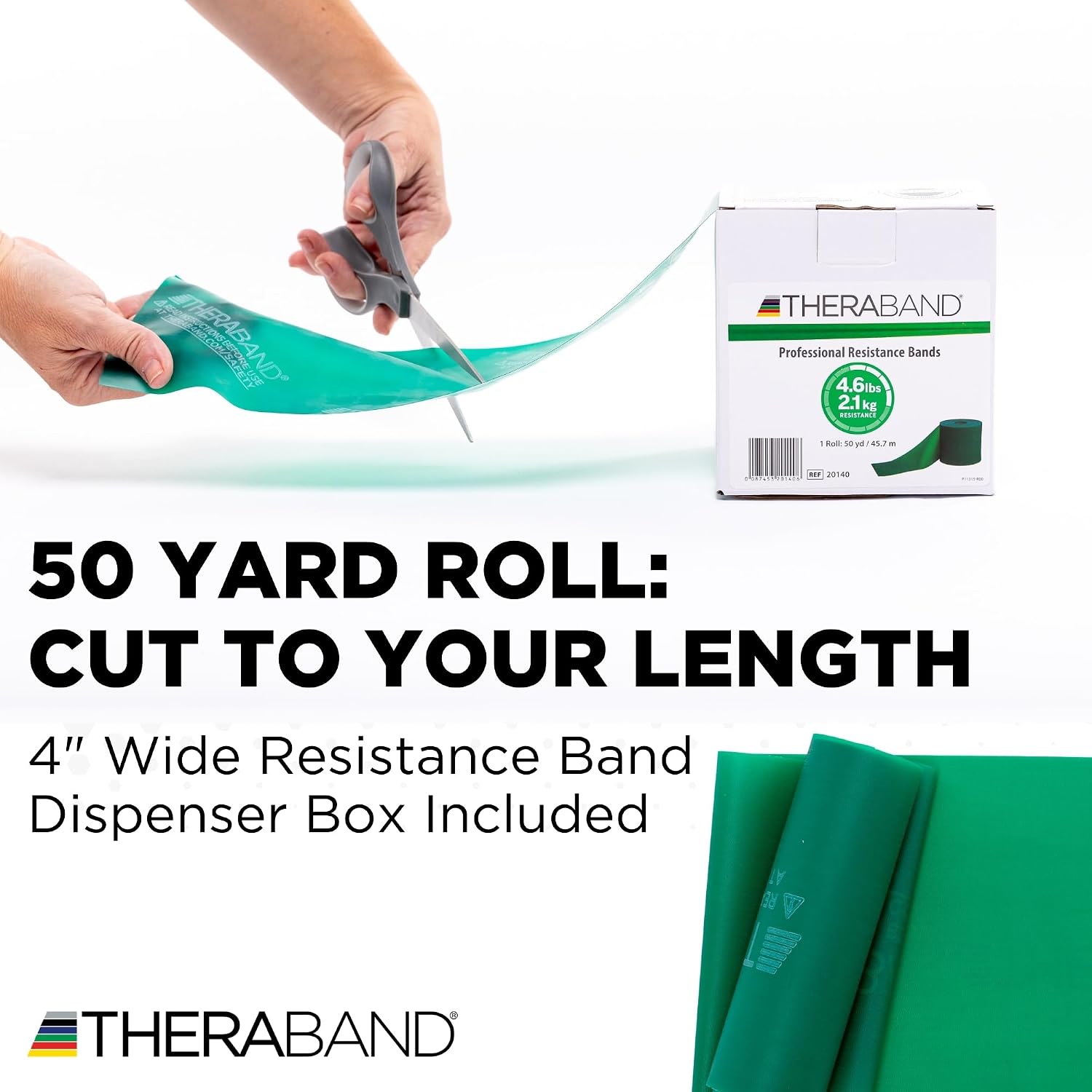
For practices running 15 or more patient sessions per week, the 50-yard bulk roll is the lowest-cost-per-unit option available. Based on pricing data published by Perform Better in their 2025 Resistance Band Buying Guide and Bulk Pricing Reference, 50-yard rolls in clinical quantities typically land between $65 and $85 depending on resistance level and distributor tier. Cut into standard 5-foot strips, a 50-yard roll yields approximately 30 strips — putting the per-unit cost well under $1, sometimes approaching $0.43 at the lower end. Over a year in a busy clinic running 20 or more patient sessions per week, that delta compounds into hundreds of dollars in supply costs.
| Format | Unit | Approximate 2026 price | Effective cost per 5-ft strip |
|---|---|---|---|
| TheraBand Pre-Cut (5 ft) | 30-pack | $38–$48 | $1.27–$1.60 |
| TheraBand Roll (6 yd / 18 ft) | Single roll | $14–$18 | ~$1.15–$1.20 per 5-ft cut |
| TheraBand Roll (50 yd bulk) | Bulk roll | $65–$85 | $0.43–$0.57 per 5-ft cut |
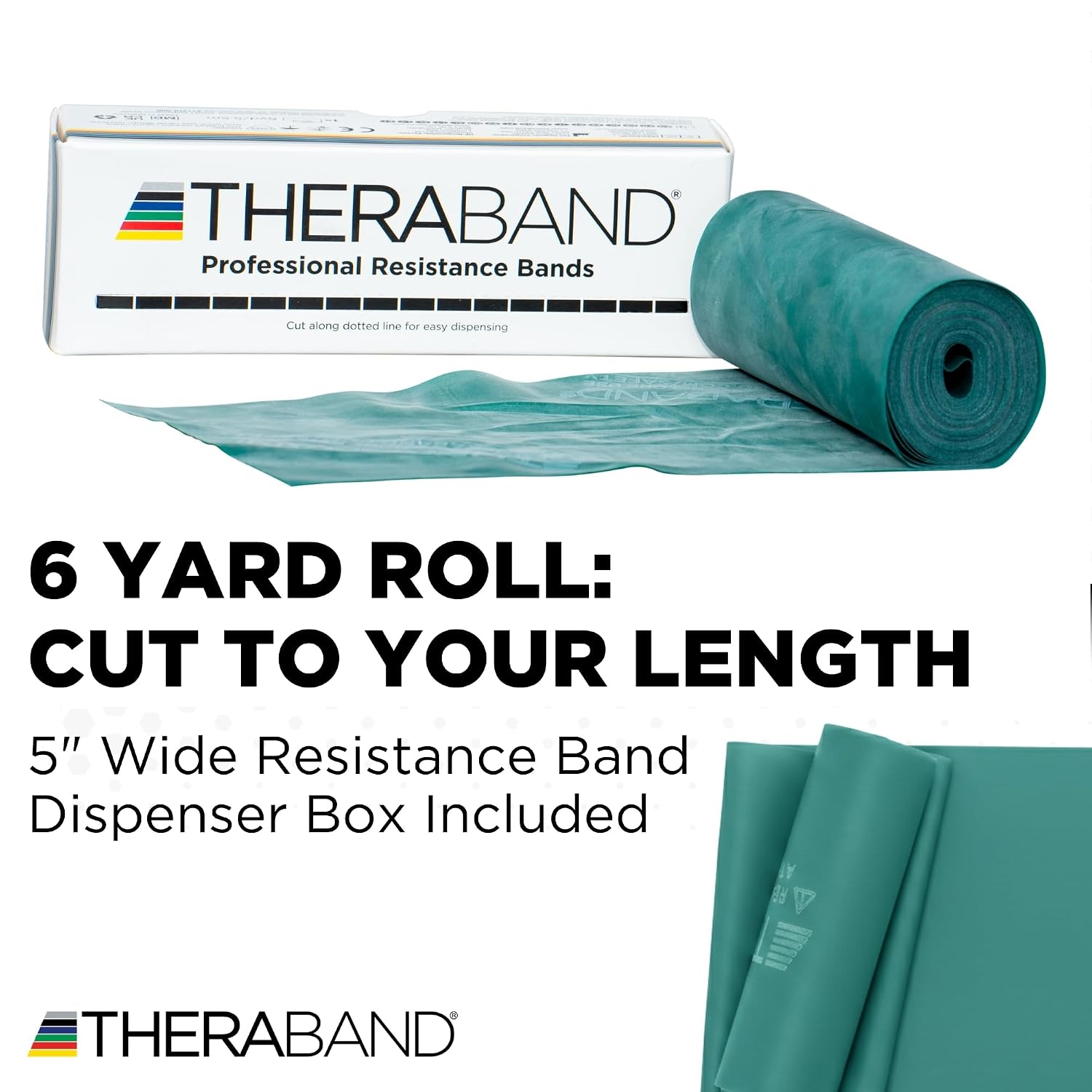
THERABAND
$14.40
In stock on Amazon
Check price on Amazon(Prices benchmarked against Perform Better’s 2025 Bulk Pricing Reference and Performance Health’s published MSRP ranges. Clinical distributor pricing varies; these are retail-level reference points.)
THERABAND
$14.40
In stock on Amazon
Check price on AmazonStronger By Science’s review of resistance band mechanics and load accommodation notes that most therapeutic protocols use bands in the 4- to 6-foot range for standard upper- and lower-extremity exercises, making the 5-foot convention a reasonable default — but the real flexibility of the roll format is that you aren’t locked into that convention. A hip abduction protocol might call for a shorter loop; shoulder external rotation work might need extra length for wrap-around grip modifications. With a roll, you cut what the exercise requires. With pre-cut bands, you work around a fixed dimension.
Mid-Tier: Single Rolls and 30-Pack Pre-Cut for Solo Practitioners
For solo physical therapists, strength coaches, or small practices running 5 to 15 clients per week, the choice between a standard single roll (6 yards) and a 30-pack of pre-cut bands is genuinely close. At this volume, the per-strip price difference between a single roll and a 30-pack is modest — roughly 10 to 30 cents per band based on Perform Better’s published retail pricing. The real question at this scale isn’t pure cost; it’s operational overhead. A single roll requires scissors, a consistent cutting protocol, and someone whose time has a cost. A 30-pack eliminates that friction entirely for a small premium that most solo practitioners find worth paying.
BarBend’s resistance band specification comparisons note that for individual coaches building client onboarding kits, pre-cut bands in sealed packaging carry a cleaner presentation than hand-cut strips — a meaningful consideration in private-pay practices where perceived value is part of the service model.
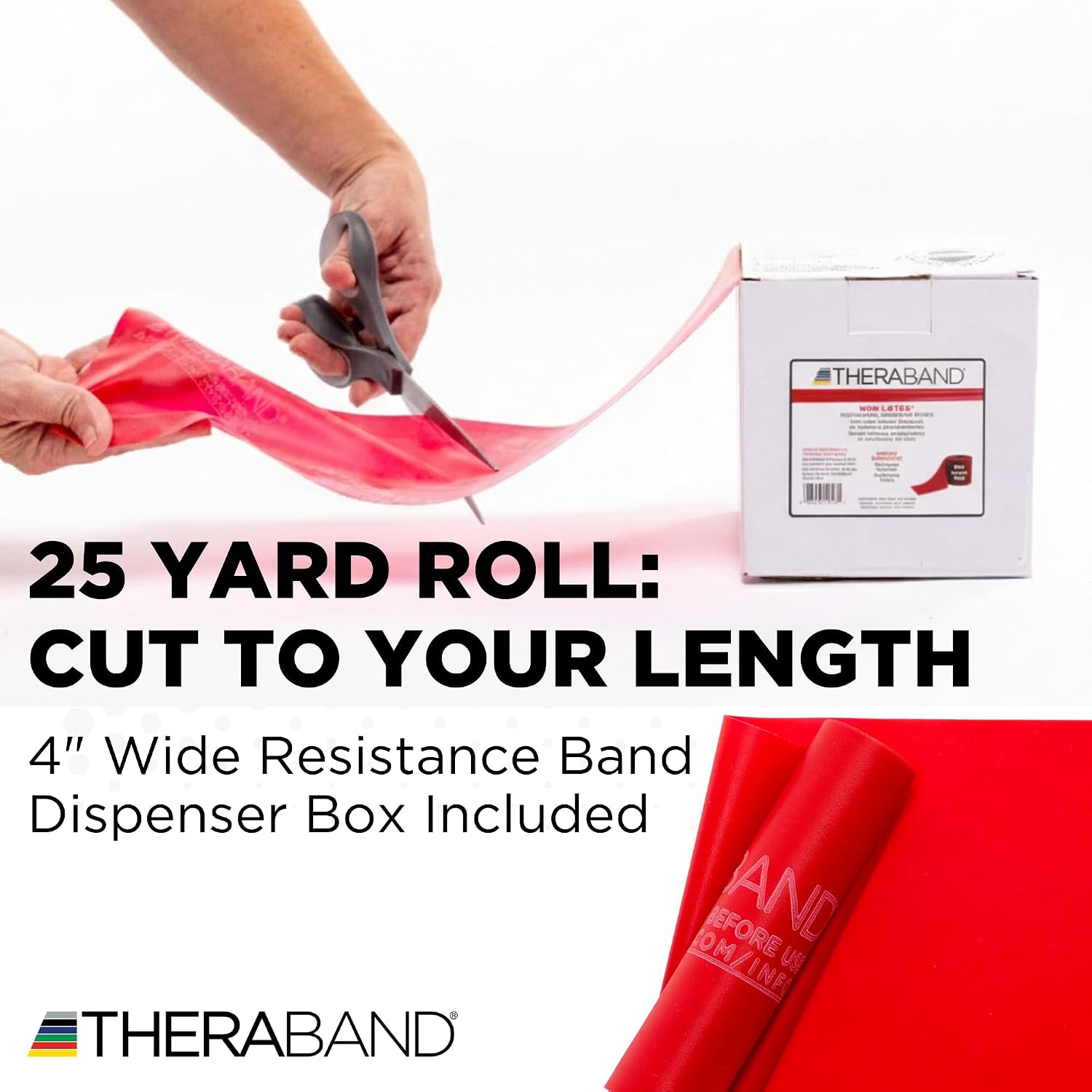
THERABAND
$35.19
In stock on Amazon
Check price on AmazonTHERABAND
$35.19
In stock on Amazon
Check price on AmazonPremium Tier: TheraBand CLX Pre-Cut Sets for Specialized Clinical Use
The CLX format — Performance Health’s trademarked design featuring integrated finger loops at regular intervals along the band’s length — is available in pre-cut lengths only, typically 5 feet, and carries a higher price point than standard flat band in equivalent resistance levels. Per Performance Health’s published TheraBand Product Catalog (2025 edition), CLX sets in clinical configurations typically run $30 to $85 depending on resistance variety and packaging.
The CLX loop design changes the grip-and-anchor equation for certain populations. Patients with limited hand strength or grip impairments — common in post-stroke rehabilitation, rheumatoid arthritis programs, and post-fracture recovery — can anchor and control the band without the grip demands of wrapping standard flat material. BarBend’s resistance band specification comparisons identify the CLX’s loop spacing as enabling consistent bilateral resistance work, which represents genuine clinical utility rather than a marketing differentiator.
The tradeoff is cost and format lock-in. CLX is a pre-cut-only product; there is no CLX roll format. If your patient population specifically benefits from the loop design, the format decision is made by default — rolls aren’t an option, and the premium is the price of that clinical utility.
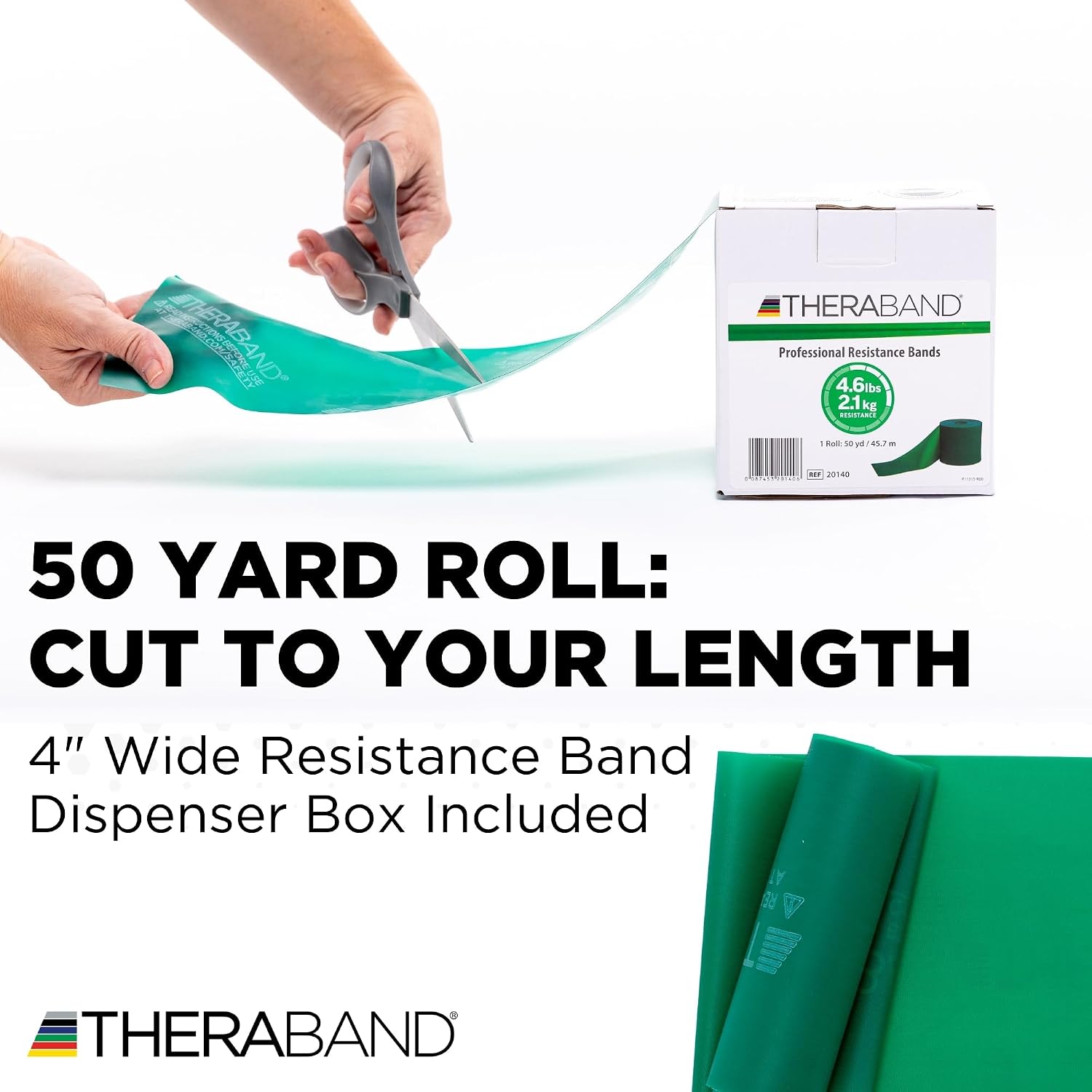
THERABAND
$80.62
In stock on Amazon
Check price on AmazonTHERABAND
$80.62
In stock on Amazon
Check price on AmazonWhere Pre-Cut Bands Earn Their Price Premium
The cost math favors rolls almost unconditionally at volume. So why do clinics and coaches still buy pre-cut bands in large quantities? There are legitimate operational reasons, and dismissing them would be incomplete analysis.
Hygiene and single-use compliance. The American Physical Therapy Association’s Clinical Practice Resources on therapeutic exercise equipment address infection control as a documented consideration in shared-equipment environments. Pre-cut bands support single-use or per-patient assignment protocols more cleanly than a shared roll: each patient gets a labeled strip that travels with their home exercise program (HEP) documentation and does not return to the clinic supply. No scissors, no cross-contamination concerns, no tracking whose band was cut from which roll. For post-surgical populations or immunocompromised patients — both groups that frequently appear in PT practices — this is not a trivial consideration.
Staff time and workflow friction. A roll requires a cutting implement, a reasonably clean workspace, and someone whose time has a cost. In a high-volume clinic where front-desk staff prep materials for the next day’s schedule, the time-per-band adds up. Owners and operators consistently report that bulk roll purchasing looks better on a spreadsheet than in practice when staff turnover is high and consistency of cut length becomes variable. Pre-cut bands eliminate that variability entirely.
Client-facing professionalism and take-home kits. For coaches building client onboarding kits or clinicians sending patients home with a complete HEP kit, pre-cut bands in sealed packaging carry a cleaner presentation. A labeled 30-pack with a resistance guide insert reads differently than a zip-lock bag with a hand-cut strip. This matters in private-pay practices where presentation signals quality of care. BarBend’s resistance band reviews consistently flag packaging and presentation as factors coaches weigh when building client-facing supply kits.
Inventory simplicity. Pre-cut bands are discrete countable units. Rolls are continuous material that gets harder to track as they are depleted. For practices using supply management software or trying to maintain consistent reorder triggers, per-unit inventory is easier to manage accurately.
Resistance Level Consistency: Does Format Affect Band Tension?
This question comes up in professional discussions more than it should, and the answer is straightforward: no, format does not affect resistance properties. The TheraBand Resistance Level Chart published by Performance Health specifies tension by color regardless of whether the band was purchased as a roll or a pre-cut strip. The material, latex formulation, and elongation-to-force curve are identical across formats. The only variable that affects resistance output is the color designation and the length at which the band is anchored — longer free length equals a different force curve at a given stretch percentage.
Where resistance consistency does vary is in cut length. If your clinic’s cut-to-length protocol allows for bands anywhere from 4.5 to 5.5 feet, you’ve introduced length variability that changes the baseline tension at a given anchor distance. This isn’t catastrophic, but it matters in precise progressive loading protocols, particularly for post-surgical ACL or rotator cuff patients where resistance increments are tightly managed. Pre-cut bands eliminate this source of variability. If you go the roll route, a simple template cut — a marked guide on the cutting surface — resolves the issue with minimal overhead.
Stronger By Science’s resistance band mechanics review notes that the percentage of elongation relative to resting length, not absolute stretch distance, governs force output. This means that two bands of different cut lengths will produce different forces at the same anchor point even if they are the same color and formulation. A consistent cut-length protocol matters when clinical precision is the goal.
The Decision Framework
Based on the cost math, operational context, and published clinical guidance, here is how to structure the decision:
Buy bulk rolls (50-yard) if:
- You’re running a multi-table clinic with 15 or more patient sessions per week and have a consistent prep workflow
- Your primary patient population does not require strict single-use or per-patient assignment protocols
- You have a standardized cut-length protocol — even a simple physical template — to maintain consistency
- Your purchasing is done in advance on a quarterly or semi-annual cycle where bulk pricing is accessible
Buy pre-cut bands (30-pack) if:
- You’re a solo PT, strength coach, or small practice with 5 to 15 clients per week — the volume doesn’t justify bulk management overhead
- Your practice model includes sending bands home with patients as part of HEP kits
- Infection control or single-use policy is a documented or regulatory requirement in your setting
- You’re building a client-facing kit where presentation is part of the value proposition
Buy TheraBand CLX pre-cut sets if:
- Your patient population includes individuals with grip limitations, neurological conditions, or upper-extremity post-surgical cases where the loop design provides genuine biomechanical advantage
- You want a single format that works for both in-clinic supervised sessions and take-home programming without format switching
- The $30 to $85 per set price point is within your per-patient supply budget
The hybrid approach: Many mid-size clinics run bulk rolls for in-clinic exercise sessions — where a clinician supervises and manages the bands — and maintain a separate pre-cut inventory for HEP dispensing. This captures the bulk cost savings for high-volume in-clinic use while preserving the convenience and hygiene advantages of pre-cut for patient take-home. It requires managing two SKUs, but the cost difference at volume frequently justifies the added inventory category.
A Note on Non-Latex Alternatives
TheraBand’s non-latex bands — available in both roll and pre-cut formats — carry a modest price premium over standard latex, typically 15 to 25 percent higher per unit based on pricing data published by Perform Better. For clinics serving populations with latex allergies, this is a non-negotiable specification, and the format decision logic above applies equally to the non-latex line. Performance Health’s TheraBand Product Catalog (2025 edition) documents that resistance levels are color-matched to the latex system for clinical continuity, so patient protocols do not require recalibration when switching between latex and non-latex formats.
The bottom line is that rolls win on economics at meaningful volume, and pre-cut bands win on workflow, hygiene compliance, and client-facing presentation. Neither answer is universally correct — but neither is genuinely ambiguous once you’ve mapped your session volume, patient population, and operational context against the cost and convenience tradeoffs laid out here. Run the per-strip math against your actual weekly usage, identify whether single-use or HEP take-home is a workflow requirement, and the decision resolves itself cleanly.
How the Tiers Compare
For readers weighing price against capability, here’s how the standout picks break down by budget level.
Best Budget Pick
At $14.40, this is the value option in this lineup — it covers the essentials without the premium-tier cost, the smart starting point if you’re weighing price against capability.
THERABAND
$14.40
In stock on Amazon
Check price on AmazonBest Mid-Range Pick
At $32.62, this is the balanced choice — it closes most of the gap to the high end while staying well short of premium pricing, which is why it’s the pick most buyers actually land on.
THERABAND
$35.19
In stock on Amazon
Check price on AmazonBest Premium Pick
At $89.86, this is the top performer here — you pay for it, but if capability and longevity matter more than the upfront cost, this is the one to beat.
THERABAND
$80.62
In stock on Amazon
Check price on Amazon